Before booking, confirm current requirements with the Thai DLD, your airline and the origin-country authority.
Source check details
Thailand’s DLD import steps were checked on 7 October 2026 against the DLD’s manuals. The other Thai import claims were rechecked on 5 August 2026 against Thai consular/DLD guidance updated 2 February 2026. This is an orientation: rules can change without notice. Before booking or travel, confirm every requirement with Thailand’s Department of Livestock Development (DLD), your airline and your origin-country authority.
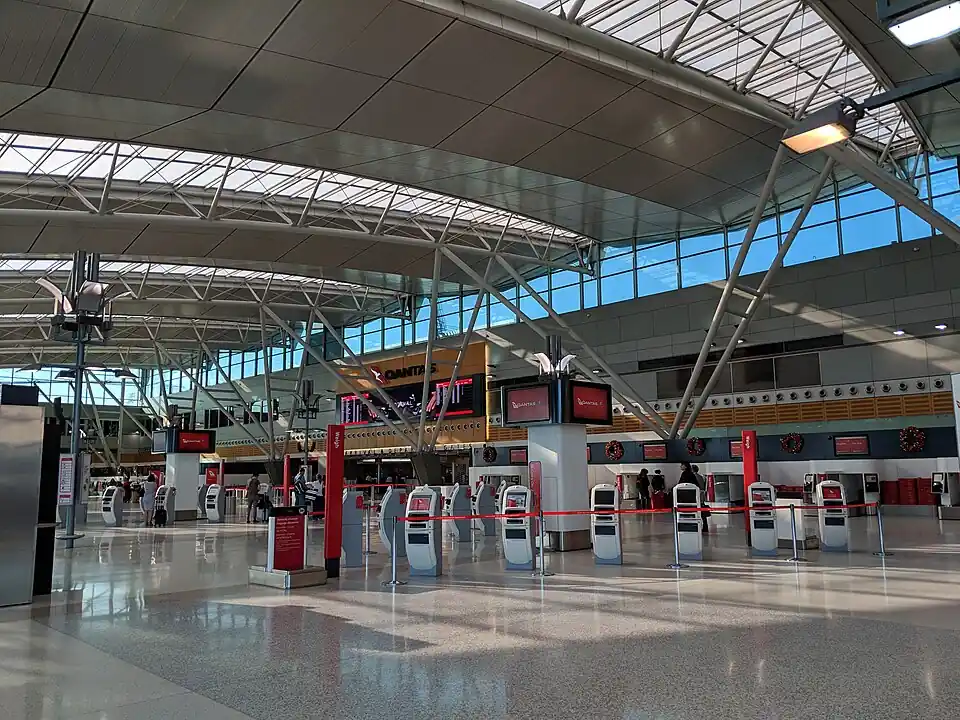
Terminal 3, Sydney Airport (2018). Photo: MDRX, CC BY-SA 4.0, via Wikimedia Commons.
The timeline — what to do when
You are juggling two governments: DAFF on the way out, DLD on the way in. Missing either timeline voids the move.
Before the Thai permit applicationRegistered Australian vet
On the AQS-confirmed scheduleDLD / arrival AQS
≥10 working days before exportDepartment of Agriculture, Fisheries and Forestry
Pre-export periodDAFF + registered vet
Final daysDAFF
Before departureAirline / relocation agent
Arrival in ThailandDLD AQS
Thai-side steps in detail: microchip, rabies, health certificate and DLD import permit.
The Australian export side (DAFF)
Australia treats every pet export as a controlled consignment. Before your pet leaves, you typically need:
- Thailand’s import conditions — including your DLD import permit, which specifies what DAFF must certify.
- A Notice of Intention (NOI) lodged with DAFF at least 10 working days before the intended export date (more for complex routes).
- Pre-export work by a registered veterinarian — examinations, vaccinations and any tests Thailand requires.
- A DAFF export permit and health certificate, issued only when DAFF is satisfied the pet meets Thailand’s conditions.
Critical detail: once DAFF issues the export permit, your pet must leave Australia within 72 hours. That is a condition of the permit — not a guideline. Coordinate your flight booking with your vet and DAFF assessment so you are not re-applying because a flight slipped.
DAFF charges time-based fees for assessment and certificate preparation, plus an export permit fee. Budget this separately from airline cargo charges — see what import costs.
Documents Thailand expects
The Royal Thai Embassy in Canberra publishes Australia-specific notes. Core requirements match the global DLD rules:
DLD application and permit
Microchip certificate
Vaccination records
Government-endorsed health certificate
Your passport
Pet photo
Flight booking
Age and breed restrictions: pets must be at least 4 months old. Pit bull terrier and American Staffordshire terrier types are prohibited from import into Thailand (airlines may impose additional breed bans).
The Thai consulate’s guide for pets from the USA directs the importer to present the animal and original documents for AQS inspection. It says the AQS issues Forms R-6 and R-7 and charges 500 baht per animal; confirm the fee for the actual route. Thai consulate guide, pets from the USA. No official source sets a general three-day arrival-confirmation rule; follow any station-specific instruction the AQS sends with the permit. See pet quarantine in Thailand and arriving at Suvarnabhumi.
If shipping cargo without travelling on the same flight, confirm the required shipper and pickup-person documents and the cargo AQS’s current operating hours directly before booking.
The return to Australia — read this first
Australia uses an approved-country biosecurity pathway for dog and cat entry. Thailand is not on Australia’s list of approved countries for direct dog and cat import. In practice, bringing a pet from Thailand back to Australia means:
- First move the pet to an approved Group 1, 2 or 3 country.
- Keep the pet continuously resident there for at least 180 consecutive days immediately before export.
- Complete Australia’s qualifying vaccinations and tests in that approved country; DAFF does not accept those steps from a non-approved country.
- Meet the approved country’s remaining permit, identity-verification, export and Australian quarantine conditions.
Returning Australian animals can have case-specific exceptions, so do not apply the standard pathway without a written DAFF assessment. DAFF source.
If you are an Australian who might one day go home with your pet, speak to DAFF and a specialist pet relocation agent before you leave Australia — not when your contract ends. Read taking a pet from Thailand to Australia for the full picture.
Do not assume the later move back to Australia mirrors the outbound process. Obtain a written DAFF pathway assessment before leaving Australia if a return may be needed.
Common mistakes Australian owners make
- Copied permit sequence — use the vaccination sequence and lead time confirmed for the actual origin by the responsible AQS, not USA-specific deadlines.
- Permit timing — applied too early (expires before you fly) or too late (AQS cannot process in time).
- Airline vs government — confirm the AQS submission method and separately obtain the operating airline’s pre-flight document list; neither is evidence of the other’s rule.
- Health certificate window — endorsed certificate expires before you land; a delayed flight can mean starting again.
- Cargo arrival hours — pets shipped as cargo may only be collected during AQS weekday business hours at some airports.
- Missing the 72-hour export window after DAFF issues the permit.
- NOI lodged too late — fewer than 10 working days before planned export.
- Doing qualifying vaccination/testing in Thailand — the standard pathway requires those steps in the approved country.
- Cargo arrival on a weekend — cargo AQS hours may delay pickup.
After the AQS inspection — reaching Pattaya
For pets from the USA, the Thai consulate’s guide says the importer presents the animal and original documents for AQS inspection, and that Forms R-6 and R-7 are issued there. The DLD allows itself up to 1 working day 6 hours to issue the R.7 (DLD import licence manual), so do not plan on same-day release. Thai consulate guide, pets from the USA. After the AQS releases the animal, use a road vehicle that explicitly accepts the animal and crate.
Your R.1/1 goes to the animal quarantine station at the airport you land at, and the import licence (R.7) is issued there (DLD import approval manual). The DLD’s list of stations names none at U-Tapao (DLD AQS map); the Chonburi station covers its district (DLD station areas), so confirm in writing before you book a U-Tapao arrival.
Settling in Pattaya
Confirm pet-friendly housing, save a local veterinary contact and discuss heat and parasite prevention with a veterinarian. Keep every stamped AQS record. For a later UK or EU journey, check the destination’s titer rules. Australia instead requires an approved-country pathway under the standard non-approved-origin route. DAFF FAQ.
Official sources
Australian sources: DAFF companion animal export; Royal Thai Embassy Canberra import guide.
Official sources to verify against: Thai consular/DLD pet-import guide (updated 2 February 2026; its detailed instruction covers only dogs, cats and rabbits from the USA); DLD import application form R1/1 (via the guide or DLD Animal Quarantine stations); Suvarnabhumi AQS import: qsap_bkk_import@dld.go.th.
Frequently asked
Can I fly my pet straight from Australia to Thailand?
The route requires DAFF export approval, the applicable Thai import documents and explicit pet acceptance from the operating airline. Confirm mode, route and conditions directly before payment.
How long does DAFF take to approve an export?
Allow at least 10 working days from lodging the Notice of Intention, often longer if documentation needs correction. Then remember the 72-hour export window once the permit is issued.
Will my pet be quarantined on arrival in Thailand?
The Thai consulate’s guide for pets from the USA does not confirm an Australia-route quarantine outcome or dependable inspection duration. Present the animal and originals as directed and ask the responsible AQS what applies to the actual route. Thai consulate guide, pets from the USA.
Can I fly my pet straight from Thailand back to Australia?
Generally no — Thailand is not an approved country for direct import. The route involves time in an approved country, an import permit, and mandatory government quarantine on arrival in Australia. Plan with DAFF and a relocation specialist.
How long does the return to Australia take to arrange?
The standard pathway includes at least 180 consecutive days of residence in an approved country immediately before export, plus that country’s veterinary, permit, export and booking steps. Ask DAFF for the case pathway before setting a date; returning Australian animals can be assessed differently.
Which airport is better for Pattaya — BKK or U-Tapao?
Plan for Suvarnabhumi unless the DLD confirms U-Tapao in writing. Your R.1/1 goes to the station at your arrival airport and the import licence (R.7) is issued there (DLD import approval manual). The DLD’s list of stations names none at U-Tapao (DLD station map); the Chonburi station covers its district (DLD station areas), so ask that station in writing before you book. From Suvarnabhumi, Pattaya is a road transfer.
What should I do after reaching Pattaya?
Confirm housing, save a local vet, keep every AQS document and ask a veterinarian about heat and parasite prevention for the individual animal.
Will I need a titer test later?
That depends on the next destination. UK and EU routes can require a titer and wait. Australia’s standard route from a non-approved origin requires an approved country first; do not assume a test performed in Thailand qualifies.