Before booking, confirm current requirements with the Thai DLD, your airline and the origin-country authority.
Source check details
Thailand’s DLD import steps were checked on 7 October 2026 against the DLD’s manuals. The other Thai import claims were rechecked on 5 August 2026 against Thai consular/DLD guidance updated 2 February 2026. This is an orientation: rules can change without notice. Before booking or travel, confirm every requirement with Thailand’s Department of Livestock Development (DLD), your airline and your origin-country authority.
Confirm the airport station before booking
Thailand’s instruction for dogs, cats and rabbits from the USA names Suvarnabhumi (BKK) and Don Mueang (DMK) among six arrival airports. That source does not confirm current intake for every origin, airline or animal. Obtain the responsible AQS’s written route confirmation before booking. Thai airport instruction, pets from the USA.
For Pattaya, arrange the onward collection point and vehicle separately. This page gives no fixed road duration because the route, traffic and hand-carried or cargo collection point can differ.
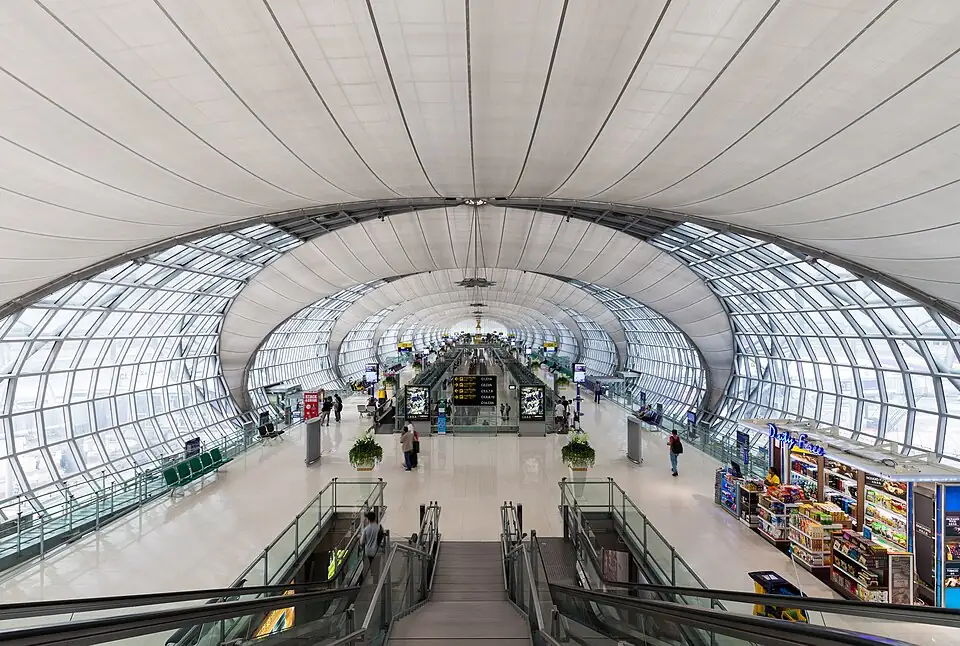
Inside Suvarnabhumi Airport, Bangkok (2019). Photo: Supanut Arunoprayote, CC BY 4.0, via Wikimedia Commons.
The Animal Quarantine Station check
The Thai consulate’s guide for pets from the USA directs the importer to present the animal and original documents to the AQS on arrival. It states that the AQS issues the Notice of Import Approval (R-6) and Import License (R-7) and charges the listed fee. It does not guarantee same-day release or publish a dependable inspection duration. Thai consulate guide, pets from the USA.
Keep the permit, endorsed health certificate, vaccination and identification records organised and available exactly as the responsible AQS directs. See pet quarantine in Thailand for the evidence boundary around a hold.
If something is missing
Do not predict the outcome from a checklist. If an original, identifier or record is questioned, ask the AQS what action it requires and follow that written direction. The guide does not provide a dependable detention or release duration. Source and limit.
Arrange a handover, not a fixed pickup time
Give the driver your flight details, animal and crate size, reachable phone number and collection location confirmed by the airline or handler. Ask how waiting charges work and how to change the pickup if inspection or release takes longer.
- Accompanied animal: confirm where the airline hands it over and how to reach the responsible AQS with the animal and records.
- Cargo shipment: ask the named handler who may collect, which identification and shipment reference they need, and where a ground vehicle may meet you.
- After release: confirm the accommodation can admit you at the revised arrival time. Keep the driver and accommodation informed of changes.
Save the handover instructions offline. Do not publish passport scans, permits or shipment identifiers in a public travel group to find help.
Getting from the airport to Pattaya
Before travel, obtain a route-specific collection plan and quote from a vehicle provider that explicitly accepts the animal and crate. Confirm where hand-carried and cargo animals are released, what waiting time is chargeable and what happens if clearance is delayed. A relocation agent is optional; getting your pet to the vet explains transport-verification questions.
Once you are settled, our guide to owning a pet in Pattaya covers the next steps, and the directory of vets helps you find a clinic near your new home.
After the AQS inspection — reaching Pattaya
For pets from the USA, the Thai consulate’s guide says the importer presents the animal and original documents for AQS inspection, and that Forms R-6 and R-7 are issued there. The DLD allows itself up to 1 working day 6 hours to issue the R.7 (DLD import licence manual), so do not plan on same-day release. Thai consulate guide, pets from the USA. After the AQS releases the animal, use a road vehicle that explicitly accepts the animal and crate.
Your R.1/1 goes to the animal quarantine station at the airport you land at, and the import licence (R.7) is issued there (DLD import approval manual). The DLD’s list of stations names none at U-Tapao (DLD AQS map); the Chonburi station covers its district (DLD station areas), so confirm in writing before you book a U-Tapao arrival.
Settling in Pattaya
Confirm pet-friendly housing, save a local veterinary contact and discuss heat and parasite prevention with a veterinarian. Keep every stamped AQS record. For a later UK or EU journey, check the destination’s titer rules. Australia instead requires an approved-country pathway under the standard non-approved-origin route. DAFF FAQ.
Official sources
Official sources to verify against: Thai consular/DLD pet-import guide (updated 2 February 2026; its detailed instruction covers only dogs, cats and rabbits from the USA); DLD import application form R1/1 (via the guide or DLD Animal Quarantine stations); Suvarnabhumi AQS import: qsap_bkk_import@dld.go.th.
Frequently asked
Will my pet be put in quarantine?
The Thai consulate’s guide for pets from the USA directs the importer to present the animal and originals for AQS inspection and says Forms R-6 and R-7 are issued there. The DLD allows itself up to 1 working day 6 hours to issue the R.7 (DLD import licence manual), so do not plan on same-day release. Ask the responsible AQS what applies to the actual route. Thai consulate guide, pets from the USA.
How do I get my pet from Bangkok airport to Pattaya?
Arrange a pet-friendly transfer in advance and obtain a route-specific quote and collection plan. Do not rely on an unsourced fixed drive time; traffic and cargo/hand-carried collection points differ.
How long does AQS clearance take?
The DLD does not publish a dependable clearance duration. Have every original and printed permit ready, and do not book a tight onward connection on this page’s authority.
What fees do I pay on arrival?
Confirm the current import, inspection and handling charges directly with the responsible AQS for the actual route. Budget for a pet-friendly transfer separately.
Can I fly into U-Tapao instead of Suvarnabhumi?
Plan for Suvarnabhumi unless the DLD confirms U-Tapao in writing. Your R.1/1 goes to the station at your arrival airport and the import licence (R.7) is issued there (DLD import approval manual). The DLD’s list of stations names none at U-Tapao (DLD station map); the Chonburi station covers its district (DLD station areas), so ask that station in writing before you book. From Suvarnabhumi, Pattaya is a road transfer.
Which airport is better for Pattaya — BKK or U-Tapao?
Plan for Suvarnabhumi unless the DLD confirms U-Tapao in writing. Your R.1/1 goes to the station at your arrival airport and the import licence (R.7) is issued there (DLD import approval manual). The DLD’s list of stations names none at U-Tapao (DLD station map); the Chonburi station covers its district (DLD station areas), so ask that station in writing before you book. From Suvarnabhumi, Pattaya is a road transfer.
What should I do after reaching Pattaya?
Confirm housing, save a local vet, keep every AQS document and ask a veterinarian about heat and parasite prevention for the individual animal.
Will I need a titer test later?
That depends on the next destination. UK and EU routes can require a titer and wait. Australia’s standard route from a non-approved origin requires an approved country first; do not assume a test performed in Thailand qualifies.