Before booking, confirm current requirements with the Thai DLD, your airline and the origin-country authority.
Source check details
Thailand’s DLD import steps were checked on 7 October 2026 against the DLD’s manuals. The other Thai import claims were rechecked on 5 August 2026 against Thai consular/DLD guidance updated 2 February 2026. This is an orientation: rules can change without notice. Before booking or travel, confirm every requirement with Thailand’s Department of Livestock Development (DLD), your airline and your origin-country authority.
The three ways a pet flies
There are broadly three options, and not every airline offers each:
- In the cabin — only where the animal plus carrier meets that operating airline’s route-specific limit and fits under the seat. There is no universal cabin-weight allowance.
- As checked baggage — your pet flies in the hold, in an approved crate, on the same flight as you, booked through the airline’s special-baggage service.
- As manifest cargo — your pet is booked as freight, large dogs or when travelling separately. Pet relocation agents usually arrange this.
Airline pet policies at a glance
Compare 17 airlines by published pet carriage mode, request timing and booking channel. Each row links to the official policy and its source-check date. Prices, flight schedules and unconfirmed conditions are not included.
| Airline | Published mode | Published request timing | Booking channel | Evidence |
|---|---|---|---|---|
| Thai Airways International (TG) | Checked baggage | At least 3 working days before departure; check in at least 2 hours before departure. | Request AVIH through a Thai Airways sales office or contact centre; other species and ineligible consignments must be arranged through Thai Cargo. | Official policy Checked 7 October 2026; evidence confidence high |
| EVA Air (BR) | Checked baggage | At least 48 hours before departure. | Contact EVA Air and obtain acceptance before travel; complete the required live-animal declaration. | Official policy Checked 7 October 2026; evidence confidence high |
| Singapore Airlines (SQ) | Checked baggage | Contact Singapore Airlines at least 2 weeks before departure. | Contact the local Singapore Airlines office before booking is finalised; carriage must remain entirely on Singapore Airlines-operated flights. | Official policy Checked 7 October 2026; evidence confidence high |
| Emirates (EK) | Checked baggage | Submit the pet travel form at least 1 week before travel and complete booking and payment before departure. | Submit Emirates' online pets travel form; Emirates confirms whether the itinerary is eligible for checked baggage or must be handled by Emirates SkyCargo. | Official policy Checked 7 October 2026; evidence confidence medium |
| Qatar Airways (QR) | Checked baggage | Submit the pet request at least 48 hours before departure; route and transport mode remain subject to confirmation. | Contact Qatar Airways and submit the live-animal request form; obtain confirmation for every sector and do not plan an inbound transfer from another airline. | Official policy Checked 7 October 2026; evidence confidence medium |
| Etihad Airways (EY) | Cabin | Submit the booking form at least 7 days before travel; provide required documents at least 72 hours before travel and arrive 3 hours before departure. | Book an Etihad-operated itinerary, then submit the Pets Onboard booking form and await confirmation before travel. | Official policy Checked 7 October 2026; evidence confidence high |
| Lufthansa (LH) | Cabin, Checked baggage | Register online at least 72 hours before departure; Lufthansa states that its Service Center may still accept a request until 24 hours before departure if capacity remains. | Register each animal with Lufthansa and wait for confirmation; transport is limited to Lufthansa-operated flights and accepted routes. | Official policy Checked 7 October 2026; evidence confidence medium |
| KLM Royal Dutch Airlines (KL) | Cabin, Checked baggage | Reserve no later than 48 hours before departure; earlier booking is recommended because capacity is limited. | Reserve through My Trip or contact the KLM Customer Contact Centre. Hold carriage is unavailable when a transfer is three hours or longer. | Official policy Checked 7 October 2026; evidence confidence medium |
| Turkish Airlines (TK) | Cabin, Checked baggage | Add the pet online up to six hours before the flight; the reservation remains subject to quota, route and operating-flight confirmation. | Add the pet while buying or managing the ticket online, or contact Turkish Airlines; obtain confirmation for the route, operating flight and available pet quota. | Official policy Checked 7 October 2026; evidence confidence medium |
| Finnair (AY) | Cabin, Checked baggage | For a hold pet, book the journey at least seven days before departure and notify Finnair via chat within 24 hours of booking. A cabin pet can be added when booking or later in Manage booking before check-in opens. | Use Finnair's booking flow, Manage booking or chat; Business and Premium Economy cabin pets require customer service. Hold carriage requires a Finnair- or Norra-operated itinerary and a Helsinki connection of at least three hours. | Official policy Checked 7 October 2026; evidence confidence medium |
| Cathay Pacific (CX) | Manifest cargo only | No public minimum booking or request lead time is stated in the reviewed policy; request shipment-specific timing from the airline. | Ordinary pets travel as Cathay Cargo manifest shipments. For direct bookings accepted from 2025-09-01 onward, the booking party must be an IPATA or ATA member, an IATA-accredited freight forwarder, or a holder of valid IATA Live Animals Regulations training. | Official policy Checked 7 October 2026; evidence confidence medium |
| China Airlines (CI) | Checked baggage | Contact China Airlines at least 48 hours before departure; acceptance is subject to flight and aircraft limits. | Reserve through the China Airlines booking department (not online). Ordinary household cats and dogs travel only as checked baggage on China Airlines- or Mandarin Airlines-operated flights; immediate transfer to another airline is not accepted. | Official policy Checked 7 October 2026; evidence confidence medium |
| Korean Air (KE) | Cabin, Checked baggage | Request service at least 48 hours before departure after buying the ticket; approval is required. | Request pet transport from Korean Air. A passenger may normally carry one pet in the cabin and two in the hold, subject to aircraft and route limits. | Official policy Checked 7 October 2026; evidence confidence medium |
| ANA (NH) | Checked baggage | Advance reservation is required. ANA directs passengers departing in four or more days to its message service and those departing within three days to contact ANA; this is a contact channel, not a guaranteed minimum acceptance deadline. | Reserve with ANA. Checked carriage is limited to ANA flight numbers operated by ANA, subject to aircraft, destination and container acceptance. | Official policy Checked 7 October 2026; evidence confidence medium |
| Japan Airlines (JL) | Checked baggage | Advance reservation is required and confirmation can take several days; check in at least 120 minutes before departure. | Reserve the animal through the JAL Contact Center after the passenger booking. Ordinary accompanied animals travel as checked baggage in the hold; unaccompanied animals use JAL Cargo. | Official policy Checked 7 October 2026; evidence confidence medium |
| Qantas (QF) | Manifest cargo only | No universal public minimum was established. International pet movements require a Qantas Freight-approved pet-travel specialist and shipment-specific booking. | Book international pet freight through an approved pet-travel specialist. Pets are not ordinary cabin or checked baggage on international Qantas services. | Official policy Checked 7 October 2026; evidence confidence medium |
| Air Canada (AC) | Cabin, Checked baggage | Register the pet within 24 hours after completing the passenger booking. More than two pets requires Air Canada Cargo contact 7-14 days before travel. | Call Air Canada after booking. Acceptance applies only to Air Canada-, Air Canada Rouge- or Air Canada Express-operated services identified by the policy; codeshare partners set their own rules. | Official policy Checked 7 October 2026; evidence confidence high |
Before you pay: a mode in this table does not prove acceptance for an animal, breed, container, airport, route, connection, aircraft or date. Assistance-animal rules are separate. Reopen the linked policy and obtain written acceptance from every operating carrier before paying.
Compare the whole itinerary
Use the same animal and container measurements for every quote. A passenger fare is not a comparable pet itinerary until each operating sector and handover has a written answer.
| Decision | Ask for a written answer |
|---|---|
| Every flight | Operating carrier, flight date, pet mode and acceptance reference for each sector. |
| Connection | Who keeps custody, where the animal waits, whether collection or check-in is repeated, and who handles transit requirements. |
| Container | Exact model, external dimensions, animal weight and combined shipment weight accepted for the aircraft. |
| Disruption | Who contacts you after a missed connection, aircraft change or temperature restriction; where the animal will be cared for. |
| Money and collection | Pet charges, excluded handling costs, change/refund terms and actual destination collection point. |
IATA’s passenger guidance directs owners to confirm acceptance for their chosen day and flight. This sheet is an editorial planning aid.
IATA-compliant travel crates
For dogs and cats covered by IATA Container Requirement 1, Edition 52 (January 2026), the acceptance check includes rigid construction, metal fasteners, the specified ventilation distribution, secure welded mesh/openings that prevent noses and paws protruding, handling spacers, absorbent bedding, a water container, labels, and dimensions that let the animal stand or sit erect, turn and lie naturally. Snub-nosed animals require dimensions 10% larger. Read current CR1.
IATA does not approve crate brands. The operating airline decides whether the exact container and animal are accepted, so obtain written route-specific confirmation before purchase and again before travel.
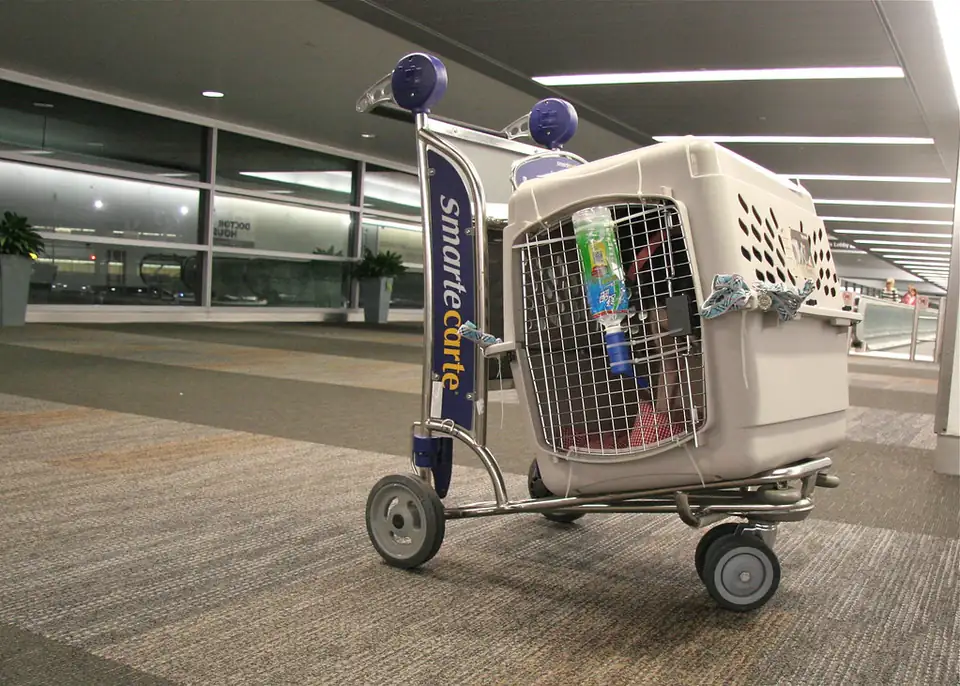
A pet travel crate on an airport luggage trolley. Photo: ilovemytank, CC BY 2.0, via Flickr.
Snub-nosed breeds and the heat
Many airlines restrict or refuse brachycephalic (snub-nosed) breeds — French Bulldogs, Pugs, Persian cats and similar — because they are vulnerable to breathing problems and heat stress in the hold. Some airlines also embargo hold travel during the hottest months. If you own a snub-nosed breed, check this before anything else — see our snub-nosed breeds & flying guide.
What comes next
With the flight booked, read what happens on arrival and budget the move in our cost guide. The Thai-side permit is the DLD import permit.
Booking the pet
Use the timing only as the policy’s stated request point, not as a safe planning buffer or a promise of capacity. Contact the operating airline when your dates are firm, identify every operating sector, and obtain written acceptance for the animal, container, route and aircraft before paying. A passenger ticket does not by itself confirm pet carriage.
After the AQS inspection — reaching Pattaya
For pets from the USA, the Thai consulate’s guide says the importer presents the animal and original documents for AQS inspection, and that Forms R-6 and R-7 are issued there. The DLD allows itself up to 1 working day 6 hours to issue the R.7 (DLD import licence manual), so do not plan on same-day release. Thai consulate guide, pets from the USA. After the AQS releases the animal, use a road vehicle that explicitly accepts the animal and crate.
Your R.1/1 goes to the animal quarantine station at the airport you land at, and the import licence (R.7) is issued there (DLD import approval manual). The DLD’s list of stations names none at U-Tapao (DLD AQS map); the Chonburi station covers its district (DLD station areas), so confirm in writing before you book a U-Tapao arrival.
Settling in Pattaya
Confirm pet-friendly housing, save a local veterinary contact and discuss heat and parasite prevention with a veterinarian. Keep every stamped AQS record. For a later UK or EU journey, check the destination’s titer rules. Australia instead requires an approved-country pathway under the standard non-approved-origin route. DAFF FAQ.
Official sources
Official sources to verify against: Thai consular/DLD pet-import guide (updated 2 February 2026; its detailed instruction covers only dogs, cats and rabbits from the USA); DLD import application form R1/1 (via the guide or DLD Animal Quarantine stations); Suvarnabhumi AQS import: qsap_bkk_import@dld.go.th.
Frequently asked
Which airlines carry pets to Thailand?
The table gives a source-dated starting point for 17 airlines, but it is not a live flight or route inventory. Open the official policy and ask every operating carrier to accept the exact animal, container, route, aircraft and date in writing.
Can my dog sit with me in the cabin?
Only the operating airline can decide. The table identifies ordinary-pet policies that publish cabin as a mode; it does not prove cabin acceptance for a specific dog, carrier, route, aircraft or date.
Do I need an IATA-compliant crate?
For hold or cargo travel, follow the current IATA container requirement and the operating airline’s route-specific acceptance rules. IATA does not approve brands, and this checklist is not an acceptance guarantee.
When should I book my pet's flight space?
Read the exact request timing in the table, then contact the operating airline as soon as your dates are firm. A published deadline is not a safe buffer or a capacity guarantee. Confirm the route, mode, container, check-in and price in writing before payment.
Can I sedate my pet for the flight?
Do not give a sedative or other medicine on this page’s authority. Ask your veterinarian about the individual animal and obtain the operating airline’s current written medication and fitness conditions before travel.
Which airport is better for Pattaya — BKK or U-Tapao?
Plan for Suvarnabhumi unless the DLD confirms U-Tapao in writing. Your R.1/1 goes to the station at your arrival airport and the import licence (R.7) is issued there (DLD import approval manual). The DLD’s list of stations names none at U-Tapao (DLD station map); the Chonburi station covers its district (DLD station areas), so ask that station in writing before you book. From Suvarnabhumi, Pattaya is a road transfer.
What should I do after reaching Pattaya?
Confirm housing, save a local vet, keep every AQS document and ask a veterinarian about heat and parasite prevention for the individual animal.
Will I need a titer test later?
That depends on the next destination. UK and EU routes can require a titer and wait. Australia’s standard route from a non-approved origin requires an approved country first; do not assume a test performed in Thailand qualifies.