Source check: Pattaya Pets reviewed this page on 1 August 2026. No licensed veterinarian or Thai legal professional has reviewed this publication. Use it as general orientation; a veterinarian must assess health or behaviour decisions, and time-sensitive local details must be confirmed at source.
Plan it before you need it
Shortlist a clinic, a backup and a transport provider that has explicitly accepted your species and containment method. For after-hours planning, use the public 24-hour claims only as leads: call in advance to confirm the current entrance, staffing and service scope, then repeat that confirmation during an incident.
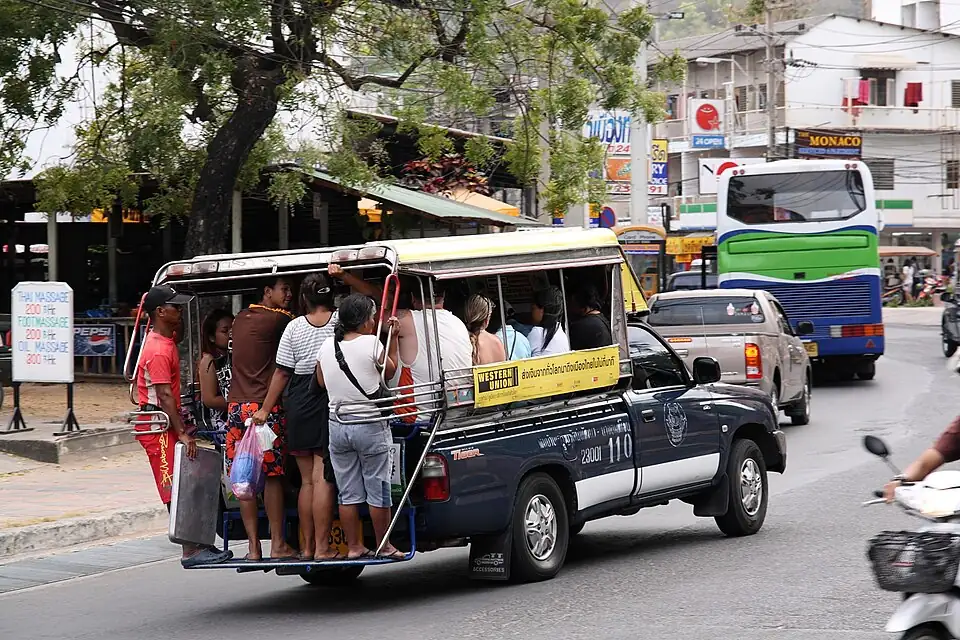
A songthaew, Pattaya's shared pickup taxi (2008). Photo: Ilya Plekhanov, CC BY-SA 3.0, via Wikimedia Commons.
Plan safe containment
Ask the clinic and transport provider what suitable containment or restraint they require for the species, size and vehicle. Acclimatise the animal to an appropriate carrier before it is needed when a carrier fits that animal. If injury or illness makes movement unsafe, describe the condition to the clinic and follow its case-specific handling instructions rather than forcing the animal into a generic method.
Taxis and ride-hailing apps
App, fleet and individual-driver policies can change. Disclose the animal and containment method before the journey and obtain explicit acceptance; do not assume a booking category permits animals. Compare lawful local options, vehicle space, ventilation, restraint and cleaning requirements. Shared or open transport may not fit an ill, frightened or uncontained animal.
Prepare two messages before travel
To the clinic: “We are at [location] with [species, size and observed problem]. Can you receive us now? What handling instructions should we follow, and which entrance do we use?”
To the driver: “The passenger includes [animal and carrier dimensions]. The destination is [confirmed clinic and entrance]. Can your vehicle accommodate this arrangement, and what is the pickup point, fare and waiting policy?”
Keep clinical questions with the veterinarian and vehicle acceptance with the provider. Share the animal’s condition when it affects the journey. If the driver cannot accommodate the arrangement the clinic advises, tell the clinic and contact the backup.
For routine care, test the route and carrier fit before the appointment day. In an emergency, follow the clinic’s live direction and do not delay veterinary contact for a trial.
Home-visit and mobile vets
Some published clinic records advertise home visits. The clinic must decide whether the requested examination or procedure fits its current mobile scope. See the mobile & home-visit vets directory for clinics that advertise off-site visits, including Baan Mor Raksasat. Do not infer emergency capability from the phrase ‘home visit’.
In a real emergency
Contact the clinic while arranging transport so it can confirm whether it can receive the case and advise on movement. If it does not answer, use the backup rather than treating silence as acceptance. Do not wait for email or a directory reply. See pet emergencies.
Evidence boundary
Cat-transport reference: FelineVMA 2025 motor-vehicle transport position. It supports carrier acclimation and veterinary guidance on carrier type and placement for cats; it does not cover every species or validate a Pattaya provider. Pattaya Pets has not completed a current market-wide audit of taxi, app or pet-transport acceptance, pricing, insurance or response time. Directory records show only the documented publication state; every journey and clinic handover needs live confirmation.
Frequently asked
Can I take my pet in a taxi or ride app in Pattaya?
Policies vary. Disclose the animal and containment method before travel and obtain the assigned provider's explicit acceptance. Keep a backup because a booking request is not proof of carriage.
How should my pet travel in a vehicle?
Use containment or restraint appropriate to the species, size, vehicle and condition, agreed with the provider. If an injury makes normal handling unsafe, ask the receiving clinic for case-specific instructions.
What if I can't get my pet to a vet in an emergency?
Call the intended clinic and backup while arranging transport. Describe the animal and ask whether it can receive the case and how to move it; do not infer emergency capability from a home-visit listing.
Are motorbike taxis safe for pets?
This page does not approve a motorcycle journey. Ask the clinic and a lawful transport provider for an option with suitable containment, restraint, space and ventilation for the animal and condition.
Should I keep a carrier in the car?
Keep an appropriate carrier accessible and inspect it before use. Ask the veterinary team how that model should be sized and secured for the animal and vehicle; a stored carrier is not automatically suitable for an injured animal.
Should I call the clinic before leaving for an emergency?
Call while arranging transport to confirm the clinic can receive the case and ask for handling instructions. If nobody answers, contact the backup rather than waiting indefinitely.
Can a home-visit vet replace a hospital in a true emergency?
Do not assume they can. The provider must decide whether its current mobile equipment, staffing and scope fit the case and whether hospital transfer is required.