Before booking, confirm current requirements with the Thai DLD, your airline and the destination-country authority.
Source check details
Thailand’s own steps were checked on 7 October 2026 against the DLD’s manuals; the other sources cited on this page were checked on 1 August 2026. Export rules change without notice. Confirm with the DLD and the destination authority before booking.
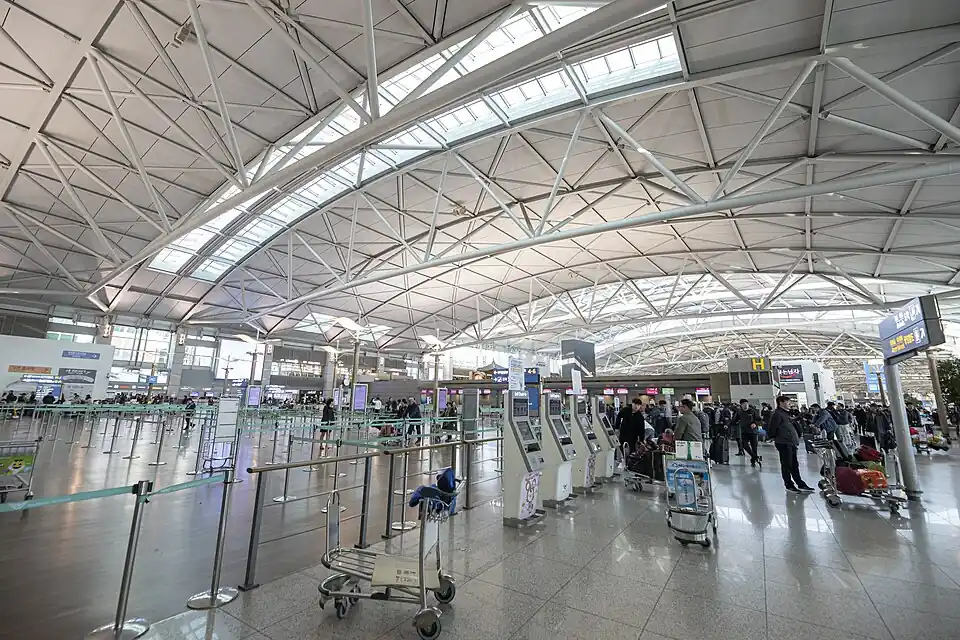
Departures, Terminal 1, Incheon International Airport. Photo: Arne Müseler, CC BY-SA 3.0 DE, via Wikimedia Commons.
What South Korea requires
Korea’s Animal and Plant Quarantine Agency (APQA) admits a pet dog or cat on documents and inspection, not on an advance licence:
- A government export quarantine certificate issued by the Thai DLD
- Microchip identification
- Rabies vaccination history
- A rabies neutralising antibody titre of 0.5 IU/ml or higher, with the MOFA page stating the test must be within 24 months before boarding
- Declaration on arrival — tick the animal box on the customs declaration form and present your pet to a quarantine officer before customs
The AIP exempts pets under 90 days old and pets coming from rabies-free countries from the antibody-result requirement. Thailand should not be treated as a rabies-free origin without current APQA confirmation. Noncompliant identification, certificates or antibody evidence can trigger quarantine action; this page does not promise same-day release.
Official conflict at exactly ten animals: the AIP says advance APQA permission is needed for more than 10 dogs or cats, while the Korean MOFA embassy page says ten or more. These sources conflict for a group of exactly ten. Obtain written APQA direction before booking rather than choosing the more permissive wording. AIP; MOFA.
Thailand’s side: apply on DLD form R.1/1 to the animal quarantine station at your departure airport, online through DLD e-Movement or in person, with all papers one to two weeks ahead. Bring your pet for the station’s health check no more than 2–3 days before the flight; the station issues the export licence (R.9: 250 baht, valid 9 days) and, on its own application, a free export health certificate, so confirm with it that both will be ready before you fly. DLD export licence manual; DLD Region 9 procedure.
The timeline — work backwards
| When | Step |
|---|---|
| Before travel | Rabies vaccination and a qualifying antibody test, unless an official exemption applies; MOFA states the test must be within 24 months before boarding |
| 2–3 days before the flight | Thailand’s side: see the DLD export steps. |
| Arrival | Declare the animal on your customs form; APQA inspection at Incheon |
Departing from Pattaya or Bangkok
Most exports use Suvarnabhumi. Allow road time from Pattaya. See Suvarnabhumi AQS (import mirror) for how the station operates.
Common mistakes
- Using a result older than the MOFA window — that source states a 24-month maximum before boarding.
- Guessing at exactly ten animals — the AIP and MOFA thresholds conflict; ask APQA in writing.
- Assuming Thailand’s entry paperwork covers Korean entry.
- Not declaring the animal on the customs form at Incheon.
If you came the other way, see our guide to From South Korea (import).
Departing from Pattaya — confirm the port and DLD sequence
U-Tapao is the nearest airport to Pattaya. It is in Ban Chang district, which the Chonburi animal quarantine station covers (DLD station areas), but the DLD’s list of stations names none at the airport (DLD station map). Get written confirmation from the Chonburi station before you plan a U-Tapao departure; otherwise plan the flight from Suvarnabhumi.
The station’s health check is no more than 2–3 days before the flight (DLD Region 9 procedure), normally at the station of your departure airport unless its vet agrees another place. From Pattaya that can mean the station visit and the flight are two separate trips, so book the visit and the transport together.
Using an agent is optional
An agent cannot change government or airline rules. If you request assistance, obtain an itemised scope and verify each regulated requirement directly with the authority. Pattaya Pets has not independently measured agents’ prices, error rates or outcomes.
Official sources
Korean sources: Korea Aeronautical Information Publication; Korean MOFA embassy guidance. Import mirror: bringing a pet from South Korea.
Official sources to verify against: DLD Region 9 export procedure.
Frequently asked
Does South Korea require a rabies titer test from Thailand?
The published route requires a result of at least 0.5 IU/ml, with exemptions in the AIP for pets under 90 days and origins designated rabies-free. The MOFA page states the test must be within 24 months before boarding. Confirm how APQA applies any exemption to the individual animal.
Do I need advance permission or an import licence for Korea?
The ordinary route relies on the government export certificate, identification and antibody evidence. For group size, the AIP says permission above ten while MOFA says ten or more. Exactly ten is unresolved in the official sources, so obtain written APQA direction. Commercial movements may follow different controls.
How long does Thailand-to-Korea pet export take?
Start with the destination: its tests, waiting periods and permit set the long lead time. For Thailand’s side, apply on form R.1/1 once the destination papers are ready, and bring your pet for the station’s health check no more than 2–3 days before the flight (DLD Region 9 procedure). The export licence (R.9) is valid 9 days and takes up to 2 working days 4 hours from complete papers (DLD export licence manual), so file everything one to two weeks ahead and ask the station to issue it before your flight.
Can my pet enter Korea through Incheon airport?
Yes. APQA’s Incheon Airport Regional Office inspects arriving pets. Tick the animal box on your customs declaration form and present the pet and certificate to a quarantine officer before customs.
What Thai documents does APQA expect?
The DLD export permit and export quarantine certificate, plus vaccination records and an antibody result whose microchip number matches every other document.
Should I use a relocation agent?
An agent is optional. Ask for an itemised scope and verify APQA, DLD and airline requirements directly; Pattaya Pets has not independently measured agent outcomes.
Can I fly my pet out of U-Tapao?
Only if the DLD confirms it in writing. U-Tapao is in Ban Chang district, which the Chonburi animal quarantine station covers (DLD station areas), but the DLD’s list of stations names none at the airport (DLD station map). Ask the Chonburi station in writing whether it can examine your pet and issue the export licence (R.9) for a U-Tapao departure; if not, plan the flight from Suvarnabhumi.
How should I plan the transfer to the departure airport?
Use a vehicle that accepts the animal and crate, confirm the airline’s check-in cut-off and leave route-specific contingency time.