Swiss rules and the FSVO country classification were checked on 26 July 2026. Direct arrival by air from Thailand needs an FSVO import licence, and dogs, cats and ferrets under seven months cannot enter from a rabies-risk country.
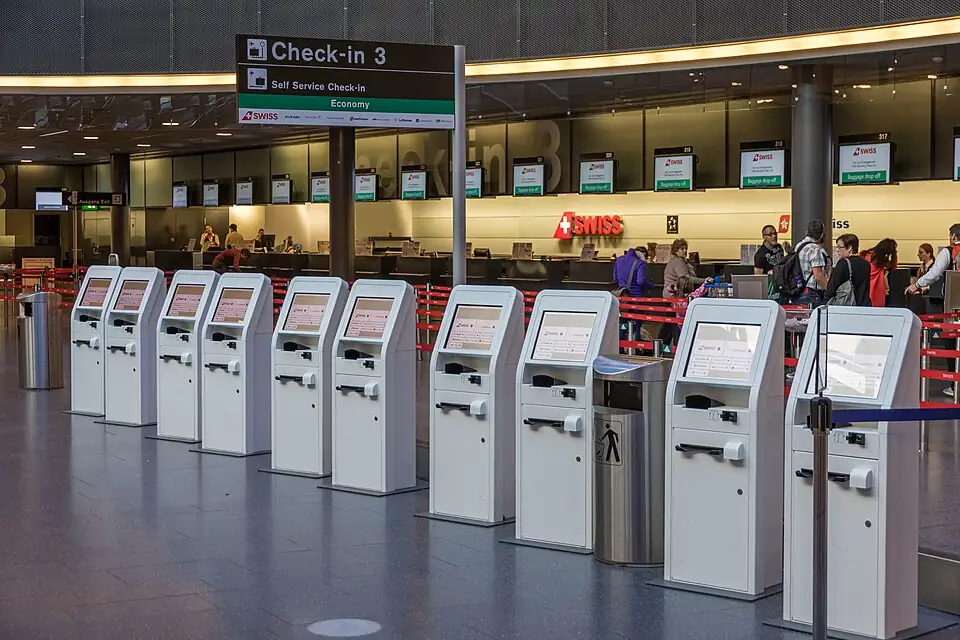
Self-service check-in at Zurich Airport (2015). Photo: JoachimKohler-HB, CC BY-SA 4.0, via Wikimedia Commons.
The timeline — work backwards from your flight
For Thailand, the titer test, waiting period and FSVO route approval are the long poles.
Month 1 (if no valid titer yet)Thai vet + EU-approved lab
At least 90 days after samplingEU Regulation 2026/131 framework
6–8 weeks before flightAirline / agent
As the responsible AQS directsDLD AQS
Within 10 days of entryDLD + official vet
Destination arrivalBorder authority
Shared EU rules: exporting a pet to the EU. Titer source; Entry source.
What Switzerland requires from Thailand
Thailand is absent from the FSVO low-risk country lists and therefore falls in the rabies-risk group. For a non-commercial dog, cat or ferret, plan for:
- ISO microchip before rabies vaccination
- Current rabies vaccination
- Rabies titer test from an approved laboratory, blood drawn at least 30 days after vaccination
- The FSVO waiting period after the blood sample
- A veterinary certificate endorsed by the exporting country’s competent authority, unless the documented Swiss/EU return-passport conditions are met
- An FSVO import licence before direct entry by air from a rabies-risk country
- Declaration through the red customs exit and entry through an allowed travellers’ point
- No entry for dogs, cats or ferrets under seven months old from a rabies-risk country
The Federal Food Safety and Veterinary Office (FSVO) oversees the process.
Have the destination authority check any earlier titer result and uninterrupted rabies record before relying on a return exception. An old passport alone does not prove eligibility. Shared EU titer reference.
Returning to Switzerland? FSVO allows a valid Swiss or EU passport when the animal already meets the required re-entry conditions. A first entry or a pet whose documents do not confirm those conditions needs the exporting authority’s veterinary certificate. The direct-air import licence and rabies-risk controls still apply. FSVO passport and certificate guidance, checked 8 September 2026.
The Thai export side (DLD)
Parallel Thai requirements:
| Thai-side document | Notes |
|---|---|
| Export licence (R.9) and health certificate | Thailand’s side: apply on DLD form R.1/1 to the animal quarantine station at your departure airport, online through DLD e-Movement or in person, with all papers one to two weeks ahead. Bring your pet for the station’s health check no more than 2–3 days before the flight; the station issues the export licence (R.9: 250 baht, valid 9 days) and, on its own application, a free export health certificate, so confirm with it that both will be ready before you fly. DLD export licence manual; DLD Region 9 procedure. |
| Destination import rules | Attach the destination authority’s import requirements (NOC, import licence, SPSIC, etc.) so the Thai health certificate matches. |
| Identification, vaccinations and tests | Carry the records required by the destination and the responsible AQS. |
See export process.
Common mistakes on this corridor
- Starting with Thailand only — destination import permits and tests are usually the long pole.
- Expired vaccinations — a lapsed rabies shot can void import clearance.
- Microchip mismatch across Thai export papers and destination import forms.
- Bringing your pet to the station too early — the health check is no more than 2–3 days before the flight, and the export licence (R.9) is valid 9 days (DLD Region 9 procedure).
- Relying on an old passport without checking eligibility — first imports need the certificate route; a return-passport exception has specific conditions.
- Entering via a non-designated point — each country lists approved entry points for pets from third countries.
Who should not use this route yet
Do not book direct air transport if the FSVO import licence is not in hand, the titer waiting period is incomplete, or the animal will be under seven months at entry. Those are eligibility conditions, not paperwork that can be fixed at the airport.
If you came the other way, see our guide to From Switzerland (import).
Departing from Pattaya — confirm the port and DLD sequence
U-Tapao is the nearest airport to Pattaya. It is in Ban Chang district, which the Chonburi animal quarantine station covers (DLD station areas), but the DLD’s list of stations names none at the airport (DLD station map). Get written confirmation from the Chonburi station before you plan a U-Tapao departure; otherwise plan the flight from Suvarnabhumi.
The station’s health check is no more than 2–3 days before the flight (DLD Region 9 procedure), normally at the station of your departure airport unless its vet agrees another place. From Pattaya that can mean the station visit and the flight are two separate trips, so book the visit and the transport together.
Using an agent is optional
An agent cannot change government or airline rules. If you request assistance, obtain an itemised scope and verify each regulated requirement directly with the authority. Pattaya Pets has not independently measured agents’ prices, error rates or outcomes.
Official sources
Swiss sources: FSVO travelling with pets; FSVO rabies country list (June 2026 PDF). Import mirror: bringing a pet from Switzerland.
Official sources to verify against: DLD Region 9 export procedure; UK pet travel; CDC animal import (USA); EU pet movement; Japan MAFF Animal Quarantine; Singapore AVS; UAE MOCCAE pet import; Australia DAFF; New Zealand MPI; India AQCS; Philippines BAI; China GACC pet entry; South Africa DALRRD import; Canada CFIA; Switzerland FSVO.
Frequently asked
Does Switzerland being outside the EU make this easier?
No. Switzerland applies its own FSVO controls alongside an EU-aligned veterinary framework. Thailand falls in the rabies-risk group, so the titer and waiting period apply; direct arrival by air also needs an FSVO import licence. The red customs exit and an allowed travellers’ entry point are part of the arrival plan.
What is the single most important step?
The rabies titer test, done as early as possible. Its waiting period is what makes the timeline long, so it is the thing to get moving first. At the same time, ask FSVO about the direct-air import licence so the route is eligible.
Is the EU pet passport enough from Thailand?
A valid Swiss or EU passport can cover a qualifying return under FSVO’s conditions. It does not replace the rabies-risk evidence or the FSVO licence required for direct air entry from Thailand. First imports and pets that do not meet the passport conditions need a veterinary certificate. Thai export paperwork still applies.
Can my pet skip the waiting period?
Only when an earlier valid titer remains usable and every rabies booster has been given without a lapse; otherwise the rabies-risk timeline applies. Confirm the individual record with FSVO before booking. An animal under seven months still cannot enter from Thailand, even if the owner has a pressing travel date.
How does this differ from exporting to the EU?
The veterinary framework is closely aligned, but Switzerland applies its own FSVO controls. Direct air entry from Thailand needs an import licence, rabies-risk origins cannot send animals under seven months, and arrival uses Swiss customs procedures. Compare the shared timeline in export to the EU, then follow FSVO for the Swiss route.
Can I fly my pet out of U-Tapao?
Only if the DLD confirms it in writing. U-Tapao is in Ban Chang district, which the Chonburi animal quarantine station covers (DLD station areas), but the DLD’s list of stations names none at the airport (DLD station map). Ask the Chonburi station in writing whether it can examine your pet and issue the export licence (R.9) for a U-Tapao departure; if not, plan the flight from Suvarnabhumi.
How should I plan the transfer to the departure airport?
Use a vehicle that accepts the animal and crate, confirm the airline’s check-in cut-off and leave route-specific contingency time.
Should I stay near the departure airport?
Decide from the confirmed examination appointment, airline check-in time and road conditions. This guide has no evidence for a universal recommendation.