Before booking, confirm current requirements with the Thai DLD, your airline and the origin-country authority.
Source check details
Thailand’s own steps were checked on 7 October 2026 against the DLD’s manuals; the other sources cited on this page were checked on 5 August 2026. Thailand's Department of Livestock Development, airlines and origin-country authorities change their rules without notice. Treat this as orientation, then confirm every current requirement with the DLD, your airline and your origin-country authority before you book or travel.
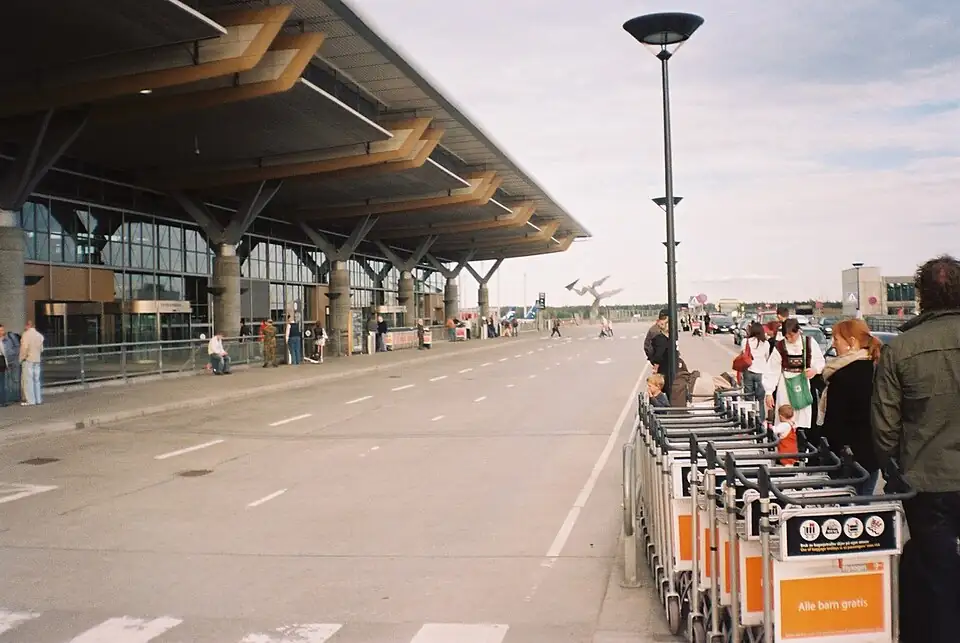
Oslo Airport, Gardermoen (2008). Photo: Radosław Botev, CC BY 3.0 PL, via Wikimedia Commons.
The timeline — what to do when
Work backwards from your flight.
| When | Step | Who |
|---|---|---|
| Before travel (if EU/EFTA return is possible) | Plan the identifier, rabies vaccination and optional rabies titer test. Under the current EU route, sample ≥30 days after primary vaccination or within a current valid series and ≥90 days before certificate issue. Commission rule | Your vet; approved lab |
| Before filing the Thai permit | Ask the responsible arrival AQS to confirm the required vaccination set and any origin-specific wait; do not use the USA-only timing as an EU/EFTA rule | AQS + your vet |
| On the AQS-confirmed schedule | Submit DLD application form R1/1 through the confirmed channel and allow the lead time supplied in writing, then obtain the import permit when required before travel | DLD / arrival AQS |
| 2–3 weeks before | Book pet space on the flight; confirm airline requires the Thai import permit before boarding | Airline |
| Final certificate window | Ask the Norwegian Food Safety Authority (Mattilsynet) to confirm the current export or health certificate for Thailand, who may complete it, whether official endorsement is required and its validity window | Origin authority + export-experienced vet |
| Before travel | Follow the responsible AQS’s current itinerary-notification instructions; the official guidance sets no general three-day rule | Arrival AQS |
| Arrival day | AQS inspection; confirm the current forms, fee and clearance process for the actual member-state route | Bangkok AQS |
Step pages: Plan these linked document stages using the responsible AQS’s route-specific instructions — microchip, rabies and the other vaccinations, the health certificate and the DLD import permit.
For shared EU/EFTA context and the country-authority checks to make before departure, see our bringing a pet from the EU guide.
The Norwegian side of the paperwork
Ask Mattilsynet which export or health certificate applies from Norway to Thailand, who may complete it, whether official endorsement is required and what validity window applies. Norway uses the EU/EFTA pet-travel system, but the passport alone does not confirm the Thailand-route process.
Use a vet experienced in export work and allow time for every step Mattilsynet confirms.
Documents Thailand expects
Use the responsible AQS’s written instructions for these route-specific document categories:
DLD import permit
Microchip certificate
Vaccination records
Government-endorsed health certificate
Flight booking
For pets from the USA, the Thai consulate’s guide says the importer presents the animal and original documents for AQS inspection, and that Forms R-6 and R-7 are issued there. It does not state a dependable release time or detention outcome for every route. Ask the responsible AQS what applies to the actual origin and itinerary. Thai consulate guide, pets from the USA.
Planning the return to Norway
Thailand is outside the current EU no-titer lists, so the standard return route from Thailand uses a valid rabies vaccination and a rabies titer test of at least 0.5 IU/ml. Sample at least 30 days after primary vaccination or within a current valid series, and at least 90 days before the animal health certificate is issued. EU authorities publish an exception for a satisfactory test completed and recorded before leaving, subject to vaccination-continuity and documentation conditions; confirm those conditions before relying on it. Commission titer rule.
Norway also keeps the tapeworm (Echinococcus) treatment rule: a dog entering Norway must be treated by a vet against tapeworm within a set window before arrival (commonly 24 to 120 hours). Build that into the return plan, and confirm the current detail with Mattilsynet. See exporting a pet to Norway.
Common mistakes on this corridor
- Using the EU pet passport alone — it is for travel within the EU/EFTA pet-travel area, not export to Thailand.
- Assuming a private-vet signature is enough — ask the origin authority to confirm the current certificate, official-veterinarian and endorsement process for Thailand.
- DLD permit timing — obtain the member-state route’s vaccination sequence, intake channel and lead time from the responsible AQS; do not import the USA-only deadlines.
- Skipping return planning — the current EU titer route puts at least 90 days between sampling and certificate issue.
- Forgetting the tapeworm treatment on return — dogs need vet-administered treatment shortly before Norway entry.
After the AQS inspection — reaching Pattaya
For pets from the USA, the Thai consulate’s guide says the importer presents the animal and original documents for AQS inspection, and that Forms R-6 and R-7 are issued there. The DLD allows itself up to 1 working day 6 hours to issue the R.7 (DLD import licence manual), so do not plan on same-day release. Thai consulate guide, pets from the USA. After the AQS releases the animal, use a road vehicle that explicitly accepts the animal and crate.
Your R.1/1 goes to the animal quarantine station at the airport you land at, and the import licence (R.7) is issued there (DLD import approval manual). The DLD’s list of stations names none at U-Tapao (DLD AQS map); the Chonburi station covers its district (DLD station areas), so confirm in writing before you book a U-Tapao arrival.
Settling in Pattaya
Confirm pet-friendly housing, save a local veterinary contact and discuss heat and parasite prevention with a veterinarian. Keep every stamped AQS record. For a later UK or EU journey, check the destination’s titer rules. Australia instead requires an approved-country pathway under the standard non-approved-origin route. DAFF FAQ.
Official sources
Norwegian / EU sources: Mattilsynet pet import; EU pet movement (Norway applies EU-aligned rules). Export mirror: taking a pet to Norway.
Official sources to verify against: Thai consular import guide (detailed scope: dogs, cats and rabbits from the United States); DLD Animal Quarantine Station map.
Frequently asked
Does Norway being outside the EU change things?
Norway uses the EU/EFTA pet-travel system, but that does not by itself establish the outbound Thailand certificate. Confirm the current document and official-veterinarian process with Mattilsynet.
What does Norway require for the return?
A valid rabies vaccination, a qualifying titer under the current 90-day pre-certificate rule and, for dogs, the authority’s tapeworm treatment. Confirm the full Norway route with Mattilsynet and the shared titer rule with the Commission. Commission rule.
Which authority endorses the export certificate?
Ask Mattilsynet (the Norwegian Food Safety Authority) whether endorsement is required, which official channel handles it and what your export-experienced vet must supply.
Will my pet be quarantined on arrival in Thailand?
For pets from the USA, the Thai consulate’s guide says the importer presents the animal and original documents for AQS inspection, and that Forms R-6 and R-7 are issued there. It does not state a dependable release time or detention outcome for every route. Ask the responsible AQS what applies to the actual origin and itinerary. Thai consulate guide, pets from the USA.
Should I do the titer test before leaving Norway?
Ask the destination authority whether a satisfactory test completed and recorded before departure qualifies for its exception, including vaccination-continuity and documentation conditions.
Which airport is better for Pattaya — BKK or U-Tapao?
Plan for Suvarnabhumi unless the DLD confirms U-Tapao in writing. Your R.1/1 goes to the station at your arrival airport and the import licence (R.7) is issued there (DLD import approval manual). The DLD’s list of stations names none at U-Tapao (DLD station map); the Chonburi station covers its district (DLD station areas), so ask that station in writing before you book. From Suvarnabhumi, Pattaya is a road transfer.
What should I do after reaching Pattaya?
Confirm housing, save a local vet, keep every AQS document and ask a veterinarian about heat and parasite prevention for the individual animal.
Will I need a titer test later?
That depends on the next destination. UK and EU routes can require a titer and wait. Australia’s standard route from a non-approved origin requires an approved country first; do not assume a test performed in Thailand qualifies.