No licensed veterinarian has clinically reviewed this page. It provides only narrow first-aid orientation where explicitly stated, not diagnosis or a treatment plan. In a current emergency, call a veterinary clinic now, follow its live instructions and travel as the clinic directs; do not delay care to keep reading.
No behaviour prediction
Appearance, location, feeding status, group size or familiarity does not let this page determine how an individual dog will respond. Do not test whether a loose dog is friendly or attempt an introduction.
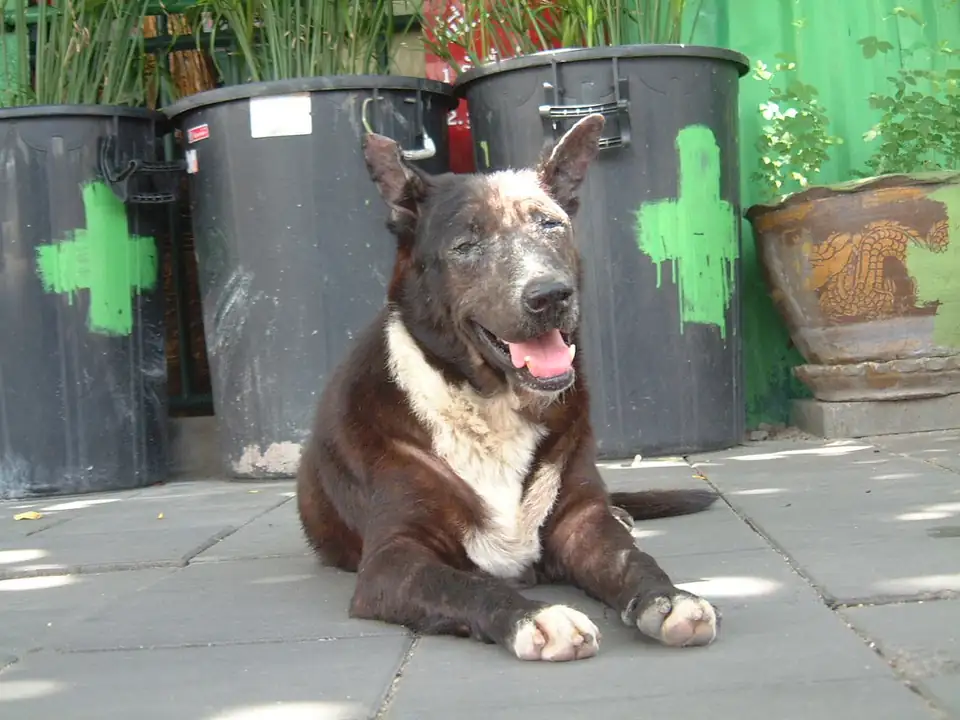
A stray dog resting on a pavement in Bangkok. Photo: Christer Torjussen, CC BY 2.0, via Flickr.
Walking your dog safely
- Keep your dog on a suitable lead and under control.
- When a loose dog is ahead, create distance and choose another route.
- Leave calmly without approaching, feeding, touching or trying to pass through a group.
- Do not use this page as a catching, restraint or fight-breaking method.
For route planning, see where to walk your dog.
If dogs approach
Keep your own animal controlled, increase distance and leave calmly. Do not attempt a body-positioning, pickup, restraint, weapon or fight-breaking technique from a generic web page. If immediate safety prevents departure, contact an appropriate local service for live assistance. AVMA’s dog-bite prevention guidance supports the narrow human-safety principles of remaining calm and backing away slowly when threatened; it does not predict this dog’s behaviour. AVMA prevention guidance.
After a bite or scratch
If your animal may have been bitten or scratched, call a veterinary clinic, describe the event and follow its handling, transport and record instructions. Do not use this page to clean, medicate or classify the wound.
If a person may have been bitten or scratched, contact an appropriate human healthcare provider immediately for a human rabies-exposure assessment. WHO says a person bitten or scratched by a potentially rabid animal should immediately seek post-exposure care. Veterinary clinics on this site are for animals; human assessment and treatment are separate. WHO rabies fact sheet.
Vaccination and local-risk boundary
Keep the animal’s records available and ask its veterinarian which vaccinations and follow-up apply. This page does not establish local rabies prevalence, a legal conclusion, or a treatment decision for an individual animal or person.
Frequently asked
Are Pattaya's street dogs dangerous?
This page does not label the population or predict an individual dog’s behaviour. Keep your own animal on a lead, create distance and leave calmly without approaching.
What if my dog is bitten by a street dog?
Call a veterinary clinic, describe what happened and follow its live handling, transport and record instructions. If a person was also bitten or scratched, contact an appropriate human healthcare provider separately.
Should I carry treats to distract street dogs?
This page does not recommend a food-based distraction technique. Keep your dog controlled, create distance and leave the encounter without approaching or feeding loose dogs.
Is it safe to walk at night?
This page has no verified time-of-day incident data and cannot label a time safe. Plan for visibility and conditions, keep your dog controlled, and change route when loose dogs are present.
What if a street dog follows us home?
Keep it separated from your pet and do not attempt handling from this page. From a safe location, contact an appropriate local animal or rescue service and follow its live advice; see adoption and rescue contacts.
Should my dog greet street dogs on a walk?
Do not use appearance to predict behaviour or initiate an introduction. Keep your animal controlled, give the loose dog space and choose another route.
Are temple dogs different from soi dogs?
This page does not assign behaviour or disease risk by location. Use the same conservative boundary: control your animal, create distance and do not approach or handle a loose dog.
What if I am bitten while protecting my dog?
Seek prompt advice from a human healthcare provider. If your dog was also bitten, call a veterinary clinic separately and follow its instructions.